

If immersive technology is a meaningful part of your roadmap, tracking hardware shipment data is one of the most practical things you can do to stay grounded in reality — and sharpen your planning.
Here are the key insights worth knowing right now.
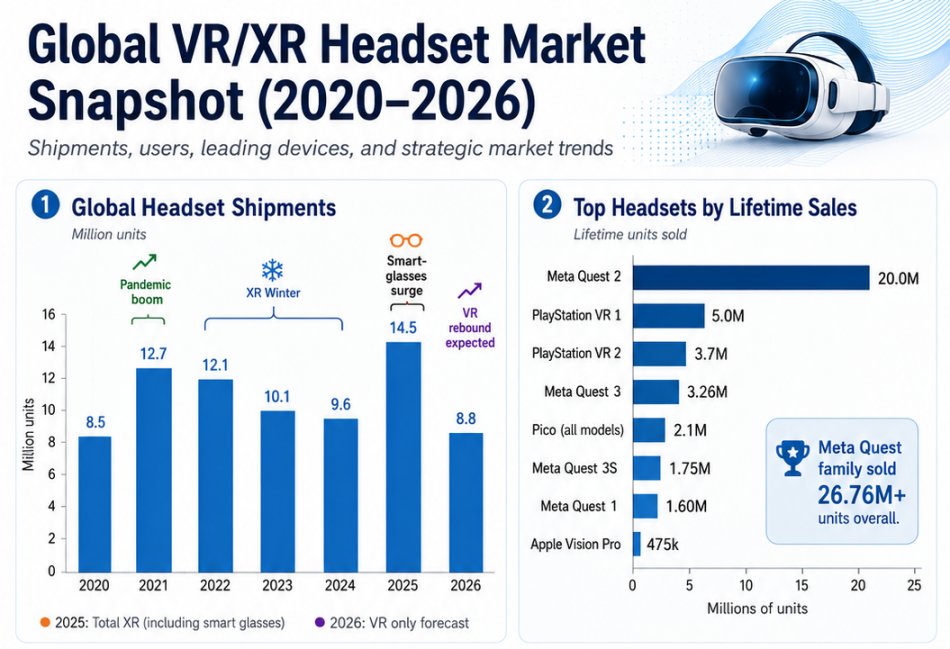
The market peaked — and that’s useful information, VR unit sales hit their high point in 2021 and have declined since. With current expectations around 8 million units shipped annually, you have a concrete baseline for sizing the addressable market. This isn’t a platform taking over the world. But in specific domains — design workflows, industrial training, simulation, and specialized education — the impact can be genuinely significant.
Users outnumber headsets by a wide margin:
Here’s a stat that surprises most people: estimated active VR users are roughly 5x the number of devices in the field. Unlike a PC or smartphone, VR headsets are routinely cleaned and shared — in classrooms, enterprise settings, and training centers. If you’re evaluating audience size, don’t anchor to device shipments alone.
If you can only support one device, make it the Meta Quest 2
More Quest 2 headsets have been sold than all other VR models combined — from Meta or anyone else. At $299, it sits at the sweet spot where consumer accessibility and enterprise adoption intersect. For anyone building VR experiences and forced to prioritize, the Quest 2 is the clear answer.
The Quest 3S is outperforming the Quest 3
This matters for planning. The Quest 3S is closer to that price-performance sweet spot, which makes it a more natural fit for institutional buyers — schools, businesses, training programs — where cost sensitivity drives decisions. The Quest 3, despite being the more capable device, isn’t moving the needle in the same way.
Choosing your ecosystem for serious (non-gaming) VR
If you’re building professional or enterprise VR — not games — you can largely set aside Sony’s PlayStation VR. It’s a consumer gaming play. For everything else, the clear hierarchy is: Meta Quest first, Pico second. If you’re going deep on one ecosystem, start there.
Don’t lock yourself into a single platform
Perhaps the most important strategic principle: avoid platform lock-in. Build experiences that run across multiple environments wherever possible. The XR landscape is still evolving, and lightweight, standalone XR devices are coming. If your experiences are portable today, you’ll be in a much stronger position when the next generation of hardware arrives.
#VR, #XR, #ExtendedReality, #VirtualReality, #MetaQuest, #ImmersiveTech, #EnterpriseVR, #EdTech, #HardwareStrategy, #EmergingTech, #ProductStrategy, #TechTrends, #Spatial Computing, #Innovation, #FutureOfWork